Professional heavy equipment transport company with 15 years of experience moving oversized loads with the right trailer, clear scheduling, and experienced handling from pickup to delivery.
★ Insured Transport ★ Nationwide Coverage
★ Permit Coordination ★ Trailer matching for all Heavy Equipment
When it comes to moving massive machines in Iowa or across the country, few things matter more than finding a reliable company that knows what it is doing. Iowa heavy equipment transport is a specialized field that takes experience, the right equipment, and an understanding of state and federal regulations. We Will Transport It brings all of that together, making it easier for contractors, farmers, and industrial businesses to move their machines safely and on time. Call (877) 880-5991 for an Iowa heavy equipment transport quote today.
Iowa heavy equipment hauling is not a one-size-fits-all service. Different machines require different trailers, and using the wrong one can damage the equipment or create safety hazards on the road. That is why specialized trailers are available for every type of load.
For low-clearance equipment, a lowboy trailer or a double-drop trailer keeps the equipment close to the ground, making it easier to go under bridges and overpasses. Meanwhile, a flatbed trailer works well for loads that are wide but not tall. An RGN trailer, which stands for removable gooseneck, is ideal for drive-on loading and is commonly used to safely transport excavators, bulldozers, and cranes. For loads that require to be tilted or slid off during unloading, a landoll trailer is a great solution. Loading and unloading assistance is always available if required, so machines get on and off the trailer without problems.
Specialized Logistics for Different Machine Types
Specialized logistics handles the paperwork and physical handling. Wide-load permitting, escort vehicles, DOT compliance, and load securement to protect the Iowa heavy equipment transport on the road.
We Will Transport It is licensed, bonded, and insured, which means the heavy haul is protected from start to finish. Heavy-duty tie-downs keep loads firmly in place throughout the move, and experienced heavy-duty machinery drivers know how to handle different weights and changing road conditions. Beyond that, we also ensure cargo insurance and liability coverage for every shipment, so that if something goes wrong, we are fully reliable.
Iowa Heavy Equipment Transport Costs and What Affects Them
Understanding heavy equipment shipping costs helps plan budgets more accurately. Generally speaking, the price to move heavy equipment in Iowa depends on fuel prices, trailer requirements, and permit costs. The Iowa heavy equipment transport costs start at $2.00 to $4.00 per mile, though that can change based on the size of the load, the distance traveled, and the number of permits that are required.
Hauling massive loads that require multiple escort vehicles or special routing has higher costs. However, getting a clear quote upfront means no surprises in the end. Our dedicated logistics specialists work through the details of the heavy haul to provide accurate pricing.
Iowa Heavy Equipment Transport Permits
Before heavy equipment moves on a road, the required permit must be in hand. The Department of Transportation handles permits for state and interstate highways. City and county roads are a separate matter, so permits for those roads are issued by the local agencies that manage them.Permit Types:
Single-trip permits handle one move approved for that route.
Multi-trip permits are for repeated moves between two locations on a single approved route.
Annual oversize or overweight permits are for carriers who haul. heavy loads throughout the year on a regular basis.
Self-propelled construction equipment permits are issued when the equipment’s axles exceed the standard weight thresholds.
Alternative energy transport permits handling moves to and from wind or solar construction staging areas.
Permits arrive by email, and electronic copies are completely legal to carry in the truck. No printing is required. Loads over 100,000 pounds are superloads and require extra review by DOT engineers before a permit is approved.
Agricultural Equipment Transporters in Iowa
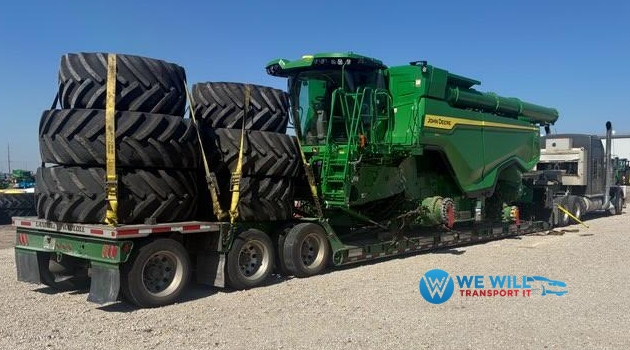
Farming in Iowa has tight schedules. When a combine needs to be moved between farms before harvest starts, or a large grain cart needs to go across the county, there is no room for delays. Agricultural equipment transport in Iowa handles everything from planters and tillage tools to large self-propelled sprayers and combines with heads detached for shipping.
Tractors of all sizes are transported frequently, whether heading to a dealership, a repair facility, or a new operation that just purchased a machine at an auction. Also, large articulated tractors can exceed the oversized load limits. Planters, particularly wide-frame models used on large Iowa operations, often require coordination with permits before transport. Our specialists ensure the safe transport of farm equipment using the proper permits and trailers.
Regulations for Moving Heavy Equipment in Iowa
Iowa has rules to protect the roads, bridges, and the drivers transporting the oversized load. Standard legal weight limits are 20,000 pounds per single axle and 34,000 pounds on a tandem axle, with a maximum gross weight of 80,000 pounds for most vehicles. Seven-axle vehicles can go up to 96,000 pounds under certain conditions.
Most oversized moves are limited to the hours between half an hour before sunrise and half an hour after sunset. Larger loads can move around the clock when roads are wide enough and have the proper lighting. Travel stops completely on Memorial Day, Independence Day, and Labor Day, and movement after noon on the day before those holidays is also off limits.
Urban corridors carry extra restrictions. Traffic on Des Moines I-235, for example, is off limits for oversized loads between 7 a.m. and 9 a.m. and again from 4 p.m. to 6 p.m. on weekdays.
Signage and lighting are not optional. Loads exceeding 75 feet long, and wider than 8 feet 6 inches, or taller than 14 feet 4 inches, require an Oversize Load sign on both the front and rear. Amber flags go on each front corner of the truck and each rear corner of the load.
Professional Oversized Equipment Hauling
Compactors, scrapers, graders, and pavers all move regularly in Iowa, and each has its own set of transport considerations. Oversized construction equipment transport for machines like these has permit requirements based on width and weight.
Forklift hauling for warehouses and auction pickups. Even though forklifts are smaller than other machines, they still require the proper deck positioning and tie-down placement. Skid steer shipping, excavator transport, and bulldozer hauling require careful weight distribution and load planning.
Concrete equipment including pumps, mixers, and placing booms, moves throughout the state. These machines often have irregular shapes and extended components that need to be folded or removed before loading.
Escort Requirements for Heavy Hauling in Iowa
Escort vehicles have a major role in keeping oversized transportation safe on roads. The rules about when one is required depend on how wide the load is and what kind of road it is being moved on.On four-lane roads, loads wider than 16 feet 6 inches require a rear escort. On two-lane roads, loads wider than 14 feet 6 inches need a front escort to warn oncoming traffic. For loads that exceed those thresholds, an amber or strobe light mounted on both the front of the towing unit and the rear of the load can sometimes stand in for a pilot car.Escort drivers must be at least 18 years old, hold a valid license, and carry proof of liability insurance. A height pole is required on the front escort vehicles whenever the load tops 14 feet 6 inches, so that clearances can be checked along the route. Escort vehicles cannot tow a trailer while on duty, and stopping traffic can only be done by law enforcement, not the escort driver.
Major Routes for Heavy Equipment Transport in Iowa
Iowa is right in the middle of the country, and that location makes it one of the busiest states for moving heavy equipment. Farms require tractors and combines hauled across the state. Construction companies need excavators and cranes delivered to job sites. Wind energy projects scattered across the plains need massive turbines moved from one end of Iowa to the other. Getting all that done means knowing the road network well.
Iowa has three main interstates and US highways that reach into every area of the state. Together, these routes give heavy haulers the flexibility to move oversized loads from the Missouri River to the Mississippi River.
The Interstate System
I-80 goes east to west across Iowa, entering near Council Bluffs on the Nebraska side and crossing into Illinois over the Fred Schwengel Memorial Bridge near Davenport. It passes straight through Des Moines and Iowa City, making it the busiest heavy haul corridor in the state. Just northwest of the Quad Cities, the route passes the world’s largest truck stop.
I-35 goes through the heart of Iowa from north to south, connecting the Minnesota border down to Missouri. It runs through Des Moines, where it overlaps with I-80, creating a major crossroads for heavy equipment moving between the upper Midwest and the South.
I-29 runs along the western edge of the state, following the Missouri River from Hamburg in the south all the way up to Sioux City and beyond into South Dakota. The terrain is flat the whole way, which makes it a smooth and reliable corridor for oversized loads heading north or south through western Iowa.
I-380 connects Cedar Rapids to Iowa City in the eastern part of the state. It serves as a key link for industrial and manufacturing moves in one of Iowa’s most economically active regions, and it ties directly into I-80 at the south end.
I-74 connects the Quad Cities area of Iowa and Illinois, providing a direct crossing of the Mississippi River for equipment moving in and out of eastern Iowa.
I-280 loops around the Quad Cities metro area on the Iowa side, giving heavy haulers an alternative to urban traffic when connecting with I-80 and I-74.
I-235 goes through the heart of Des Moines. Keep in mind that oversized loads are restricted on this route during weekday morning and evening rush hours, so scheduling matters.
I-129 and I-480 / I-680 serve the greater Omaha-Council Bluffs metro area, where Iowa meets Nebraska. These routes handle heavy cross-state traffic and connect western Iowa to the national freight network.
The US Highway Network
US-20 stretches east to west across northern Iowa, going from Sioux City through Fort Dodge and Waterloo to Dubuque on the Mississippi. It is one of the most important secondary corridors for moving farm and construction equipment in the northern half of the state.
US-30 crosses central Iowa from the Nebraska border near Missouri Valley to Clinton on the Mississippi River. It passes through Boone, Ames, Marshalltown, and Cedar Rapids, serving a wide range of agricultural and industrial areas that regularly require heavy equipment to be moved.
US-61 goes along the eastern edge of Iowa, from the Mississippi River corridor in Dubuque down through Davenport and Burlington to Keokuk. It connects Iowa’s river cities and serves as an important route for haulers working the eastern side of the state.
US-65 travels north to south through central Iowa, passing through Des Moines and linking communities up toward Mason City in the north and down to the Missouri border in the south. It provides a solid alternative to I-35 for moves that stay closer to the center of the state.
US-18 goes through northern Iowa from east to west, going from the Minnesota border near Decorah over to the South Dakota border near Rock Rapids. It reaches rural communities and agricultural operations that sit well off the main interstates.
Iowa’s road network is built to handle large loads. With more than 110,000 miles of public roadway across the state. The combination of interstate highways and US routes means equipment can move efficiently from any major city to the most rural job site in the state.
Iowa River Ports and Freight Terminals
Iowa has a geographic advantage that very few states have. It is the only state in the country bordered on two sides by navigable rivers, with the Mississippi River on the east and the Missouri River on the west. Together, these two waterways give Iowa access to a massive inland waterway network that reaches the Gulf of Mexico and, from there, ports across the world.
More than 60 barge terminals operate along Iowa’s borders, with most of them on the Mississippi side. These terminals handle a large volume of freight each year and serve as intermodal connection points where over-the-road heavy equipment transport meets the river system.
Port of Dubuque sits in the far northeast corner of Iowa, with several active barge and fleeting terminals that handle grain, fuel, and bulk industrial materials.
Port of Clinton handles agricultural and bulk freight along the upper Mississippi and serves eastern Iowa commodity shipping operations.
Port of Davenport has one of the highest concentrations of barge terminals in the state, with strong connections to I-80 and I-74 for intermodal heavy freight.
Port of Bettendorf works alongside Davenport as part of the Quad Cities port area, supporting intermodal freight movement where river barging meets major interstate access.
Port of Muscatine operates along US 61 with established bulk commodity handling and consistent river freight activity serving Muscatine County industries.
Port of Burlington sits along the US 34 corridor and provides freight terminal access for the southern half of the state.
Port of Keokuk is the southernmost port on Iowa’s Mississippi border and the northernmost Mississippi River port that stays open to barge traffic year round, thanks to a large lock chamber that fits an entire barge tow at once.
Port of Sioux City is the largest commercial port on Iowa’s Missouri River side, with direct connections to I-29 and US 20 serving the freight needs of northwest Iowa.
Port of Blencoe in Monona County opened in 2021 and is the northernmost barge terminal on the Missouri River, giving western Iowa freight operators a direct water connection and reducing overland truck miles for bulk commodity moves.
For heavy equipment hauling, our specialists know where the river terminals are relative to major highway corridors to improve routing and reduce the number of permitted overland miles.
Free Iowa Heavy Equipment Transport Quote
If you are looking for reliable Iowa heavy equipment transport services, let We Will Transport It know the load details, including the machine type, dimensions, pickup location, and destination. From there, our dedicated logistics specialists will provide a transport plan that handles everything from trailer selection to permits or escort coordination, if required.
Whether it is Iowa heavy equipment transport for excavators and bulldozers, or moving industrial equipment, the process stays consistent. Safe heavy equipment delivery across Iowa is the result of careful planning, the right equipment, and experienced drivers. Call (877) 880-5991 for an Iowa heavy hauling quote.
Heavy Equipment Transport Costs From and To Iowa
Heavy Hauling Costs from Iowa:
From – To
Miles
Shipping Quote
Heavy Haul Trucking from West Des Moines, Iowa, 50266 – Arcata, California, 95521
1,910 miles
$5,875
Heavy Haulers from Des Moines, Iowa, 50320 – Concord, New Hampshire, 03303
1,284 miles
$5,210
Equipment Transport from Davenport, Iowa, 52802 – Brooklyn, New York, 11213
951 miles
$4,500
Shipping Oversized Machinery from Cedar Rapids, Iowa, 52401 – Andover, Massachusetts, 01810
1,283 miles
$4,850
Hauling Equipment from Dubuque, Iowa, 52001 – Cave Creek, Arizona, 85327
1,743 miles
$6,250
* Prices shown above are from previous jobs we completed; they fluctuate depending on diesel and the time of the year.
Heavy Equipment Shipping Prices to Iowa:
From – To
Miles
Shipping Quote
Heavy Haulers from Denver, Colorado, 80229 – Council Bluffs, Iowa 51501
534 miles
$1,785
Equipment Shipping from Provo, Utah, 84606 – Dubuque, Iowa 52001
1,290 miles
$4,250
Heavy Haul from Jackson, Wyoming, 83001 – Marengo, Iowa, 52301
1,149 miles
$3,750
Heavy Haul Trucking from Mead, Washington, 99021 – West Des Moines, Iowa 50061
1,482 miles
$5,100
Heavy Equipment Transport from Memphis, Tennessee, 38118 – West Branch, Iowa, 52358
565 miles
$1,950
* Prices shown above are from previous jobs we completed; they fluctuate depending on diesel and the time of the year.
Who provides the best and most affordable heavy equipment hauling in Iowa?
At We Will Transport It, we’re known for delivering quality service with affordable pricing. The cost of Iowa heavy equipment hauling depends on the size, weight, route, and distance for your heavy load. We offer free, no-obligation quotes so you get an idea of the best rate for your shipment.
Do I need oversize load permits for heavy equipment in Iowa?
Yes. Due to Iowa’s regulations, special permits are required for oversized or overweight equipment. Luckily, our logistics team handles all state DOT permits and escort requirements, so that you don’t have to. We ensure that your heavy load legally complies with Iowa’s rules, from start to finish.
Which Iowa cities do you provide heavy hauling services to?
We provide heavy haul services to the entirety of Iowa, we deliver to Des Moines, Cedar Rapids, Davenport and even Iowa City. We also ship to rural or workplace areas such as farms and construction sites. As long as there’s enough space for our drivers to maneuver, we can deliver there.
How much does it cost to ship heavy equipment in Iowa?
On average, Iowa heavy equipment transport costs between $3 to $5 per mile for standard loads. Oversized or overweight machinery that requires special permits or escorts can range from $6 to $9 per mile, depending on route and distance. However, final pricing is based on equipment weight, dimensions, and pickup and delivery locations.
What types of trailers are used for Iowa heavy equipment shipping?
We have a variety of trailers to choose from to match your heavy machinery’s dimensions and weight. We use lowboys, step-decks, flatbed and removable gooseneck trailers and carefully pair the machinery to the right trailers for a safe delivery.
How should I prepare my heavy equipment for transport in Iowa?
Before pickup, clean your machinery, remove or secure any attachments, check for leaks, and drain excess fuel or other fluids. Preparing your heavy equipment ensures a smoother shipment and prevents any damages.
How do you transport heavy equipment?
There’s a wide variety of manufacturing and construction equipment in service throughout the USA, and a wide variety of trucks and trailers are available to haul that equipment to and from the job site. If you can’t tow the equipment, you can transport it to the job site on a flatbed trailer. A standard flatbed is the most common mode of heavy equipment transportation in Iowa, but you’ll need a specialty trailer to transport oversized machinery. Step-deck and lowboy trailers are excellent options to accommodate taller cargo and meet highway height restrictions. Removable gooseneck (RGN) trailers are ideal for tall and long equipment. The trailer’s gooseneck detaches from the flatbed and the trailer becomes a ramp to facilitate easy loading and unloading. The gooseneck is securely re-attached after loading and the trailer will be ready to hitch up to the tow vehicle. Our shipping and transportation experts will help you select the correct type of truck for your pick-up and ensure you get a great deal on your shipping costs.
How do you transport machinery?
You should consult your owner’s manual to determine the safest and most effective way to transport machinery. If anything needs to be removed and disassembled before transit, follow the directions carefully and keep track of all the parts. You’ll also need to unplug your equipment and secure all levers and panels before it’s hitched to the tow vehicle or loaded onto the trailer. Ensure the machinery is secured before you get on the road, and recheck all clamps and straps each time you stop. You’ll need to obtain all necessary transportation permits in advance, and a fully licensed operator should transport your equipment.
Heavy Equipment Transport Jobs To & From Iowa
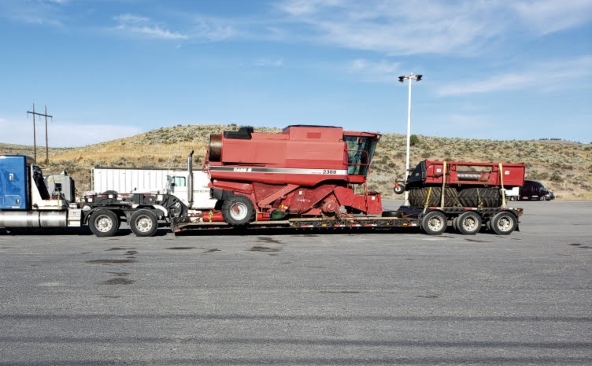
Case IH 2388 Combine Haul from Ames, IA to Columbus, NE
From: Ames, Iowa
To: Columbus, Nebraska
Art moved a Case IH 2388 Axial-Flow combine harvester from Ames, Iowa, to Columbus, Nebraska, using a RGN trailer built to handle the weight and height of large farm machines. The load was chained down tight, balanced over the trailer deck, and cleared for state permits before hitting the road. It’s a typical Midwest job moving the big equipment that keeps farms running when harvest season rolls around.
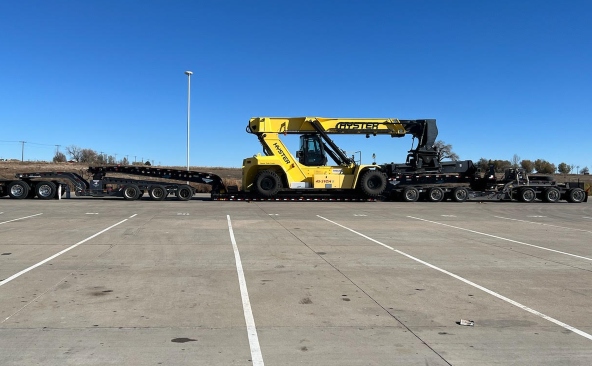
Moving a Hyster Container Handler from California to Iowa
From: Port of Los Angeles
To: Cedar Rapids, Iowa
Art took on a tough haul moving a Hyster container handler from the Port of Los Angeles all the way to Cedar Rapids, Iowa. The machine was loaded on a 13-axle lowboy RGN trailer, built to handle extreme weight and balance. Every mile of this trip was carefully planned, from securing permits to checking axle spacing, making sure the handler made the long trip safely. This kind of transport takes real hands-on experience with heavy equipment hauling and port-to-state deliveries.
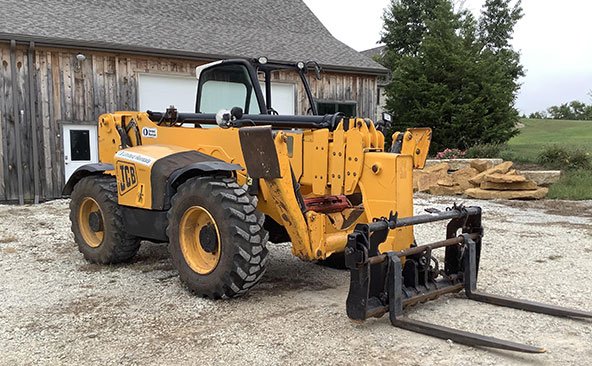
Ben in the oversize department received a phone call to move a 2014 Skytrak 6042 Telehandler from Iowa to Wyoming. The telehandler was only twenty feet long, which would be a partial load on a trailer. We moved it for two dollars a mile to the carrier.
Hauling a 2014 New Holland 499 Haybine from IA to ND
We have to haul a 2014 New Holland 499 Haybine (21.6 long, 13.9 Wide, 6.2 High, 4,500 lbs) from Iowa to North Dakota. Once our driver got the permits to move the tractor, we found an RGN trailer to pick up. By law, you can only transport one permitted load onto a trailer. We had to charge the customer for a full load which they understood. There is no way of getting around specific laws in logistics.
Hauling a 2009 Caterpillar D6T LGP Dozer from CO to IA
Daniel assisted in moving a 2009 Caterpillar D6T LGP Dozer weighing 55,000 LBS about 550 miles from Henderson, CO, 80640, to Missouri Valley, IA, 51555.
This is a wide load, with a blade that measures 12’10”, requiring several permits and an escort car for safe shipping.
If you need to transport heavy equipment from or to Iowa, contact Dan: 203-721-6969.