The Texas Legal Limits and Permit Requirements
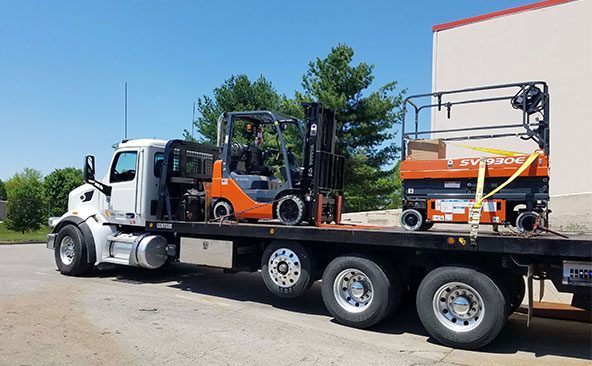
The state of Texas requires a permit for anything over 8 feet wide, 14 feet tall, 65 feet long, or 80,000lbs. Pilot cars are required past certain width limits. Going through San Antonio, Austin, Dallas, and Fort Worth, wide loads are restricted to moving after midnight and must be off the road before morning. Truck stops along I-10 and I-35 fill up with rigs waiting on those windows to open.
Hauling Heavy Equipment In Texas
The corridors, crossings, and Gulf ports that keep the state’s heavy machinery moving.
Texas Heavy Haul & Port Corridors
Somewhere in Texas tonight, a drilling rig is on the road. So is a wind turbine tower, a pressure vessel, and a bridge beam. The state moves freight at a scale most people never see up close, and the roads that carry the load were not designed for the haul. They got used to it anyway, and over time, certain corridors became the ones everybody uses.
I-10 El Paso to Beaumont
This is the road that ties the state together from west to east. Loads out of the Permian Basin head east on I-10 toward Houston. Cargo off the ship channel heads west toward the oilfields. San Antonio sits roughly in the middle, and freight coming up from Laredo on I-35 joins the flow there. More permitted oversized loads move on I-10 than on any other road in Texas.
I-35 Laredo to Dallas
Laredo is the busiest land port in the United States by trade value. Everything that crosses into Texas heads north on I-35 through San Antonio and Austin, then up to the Dallas and Fort Worth areas. Industrial machinery, fabricated steel, and construction equipment from Mexican plants. Austin creates problems for wide loads, so operators who need to avoid the city’s dimension restrictions take State Highway 130 instead. It runs parallel to the east, has fewer restrictions, and is nearly empty after midnight.
I-20 and I-45 The Basin and the Coast
From Dallas, I-20 goes southwest toward Midland and Odessa. The Permian Basin boom made this one of the most active heavy haul routes in the country. I-45 runs between Houston and Dallas and carries loads north out of the ship channel. Equipment heading for West Texas usually goes up I-45 first, then turns west onto I-20 at Dallas.
The largest loads require route surveys, and if the route crosses aging bridges, TxDOT requires an engineering review before a permit is issued.
The Gulf Ports
Houston is where the serious project cargo comes in. The ship channel is deep enough and well equipped to accommodate wind components, modular refinery sections, and fabricated industrial equipment that has no other way into the country. It is the top export port in the United States by tonnage, and for heavy freight operators, it is the starting point for most major moves.
Beaumont sits just east of Houston and handles petrochemical cargo, as well as military vehicles and equipment that the Army routes through there for staging. Corpus Christi is the port that the oil and gas industry uses for its physical gear: steel pipe, offshore hardware, turbine parts going to the Eagle Ford and the fields around it. US-77 and US-181 take that freight inland. Galveston and Texas City are next to each other on the barrier island and handle cargo that drives straight on and off the ship, feeding onto I-45 toward Houston. Freeport is smaller, south of Houston on SH-288, and it moves LNG and petrochemical cargo for the plants along that stretch of coast.
Reliable Trailers for Every Texas Heavy Haul
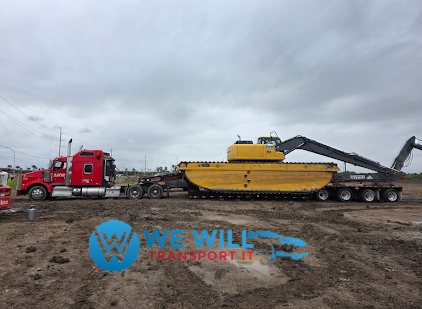
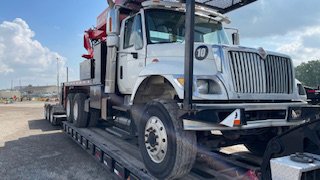
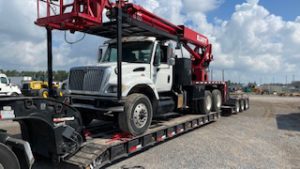
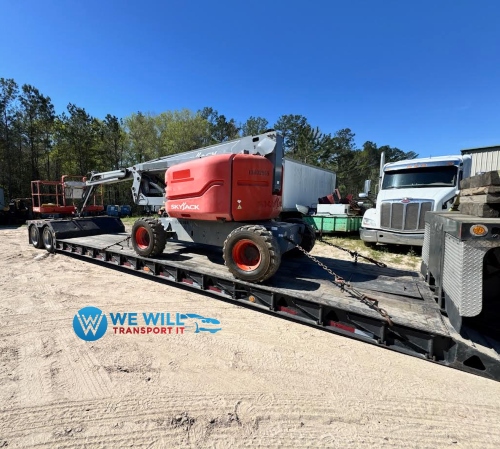
Having the proper trailer makes a huge difference for any heavy equipment. We ensure specialized trailers for different equipment types. For machines that require to drive on and off during loading, an RGN trailer is a great choice. When the equipment is extremely heavy or tall, a lowboy trailer moves the load safely. Flat and standard loads move on our flatbed trailer without any issues. For unusually long or shaped machines, we use a landoll trailer, while some heavy loads require a double-drop trailer to keep them within the legitimate height limits.
Our drivers are experienced with every trailer type. This means loading and unloading assistance is offered for every Texas heavy equipment transport, and your equipment gets handled properly.