At We Will Transport It, we are also experienced in shipping heavy machinery beyond Massachusetts state lines. We can ship from Boston, MA to New York and from Springfield, MA to Pennsylvania. Our logistics network covers every route in the entirety of Massachusetts.
Our drivers are licensed for interstate heavy haul operations and stay compliant with all DOT and FMCSA regulations across multiple states. We handle the multi-state permits and weight station coordination to escort vehicles for oversize loads, so that your shipment crosses the state borders smoothly and legally.
We regularly move heavy equipment between Massachusetts and:
- New York and New Jersey for industrial, construction, and port shipments
- Connecticut and Rhode Island for local construction and municipal projects
- Maine, Vermont and New Hampshire for forestry, farming, and energy operations
- Pennsylvania and Ohio for manufacturing and infrastructure development
With nationwide coverage, we can also arrange coast-to-coast or long-haul deliveries for cranes, bulldozers, excavators, or entire fleets. Every shipment includes full insurance, live tracking, and constant communication from pickup to delivery.
The Main Roads Used for Heavy Hauls Across Massachusetts
The Mass Pike is the road most drivers rely on to move heavy equipment from one side of the state to the other. It runs from the New York border to Boston and connects to other major highways along the way. Route 495 is the outer highway loop that circles Boston and is popular with heavy haul drivers who want to avoid the congestion and tighter roads inside the city. Routes 93 and 95 are the main north and south options and handle loads moving toward New Hampshire, Maine, or Rhode Island. Route 6 runs through the southeastern part of the state and is the main route to the Cape Cod area.
For loads coming in from Connecticut or Rhode Island, Routes 95 and 44 are common entry points into southeastern Massachusetts. Route 2 runs across the northern part of the state and connects to the Vermont and New Hampshire borders, which makes it useful for loads coming down from northern New England. Drivers hauling wide or tall loads need to pay close attention to low bridges and overhead utilities along secondary roads since the main interstates are generally more forgiving for oversized equipment.
Heavy Machinery Preparation
To prepare your heavy machinery for our professional loading and transport, simply drain all fluids (fuel, oil, coolant, hydraulics) and disconnect the battery. For a smooth delivery process be sure to secure or remove loose parts, attachments, doors, and valuable accessories. Our team handles the rest such as inspection, loading, securing, permitting, and safe unloading. Just make sure the machine is clean, powered down, and ready to roll.
Massive Equipment Transport Massachusetts
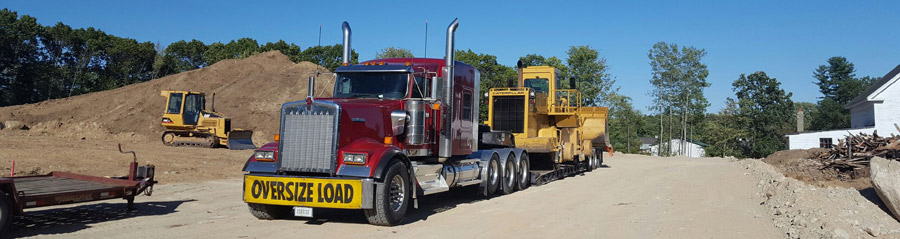
Ports and Water Access for Heavy Equipment in Massachusetts
Massachusetts has a few ports that play a real role in moving heavy equipment in and out of the region. The Port of Boston, which operates through Conley Terminal in South Boston, is the state’s largest and most active port. It handles large cargo shipments and has the crane capacity and dock space needed to load and unload heavy machinery. For companies bringing in equipment from overseas or shipping it out, Boston is usually the first call.
Fall River and New Bedford are two other port cities worth knowing about. Both are located in the southern part of the state, along the coast, and have handled industrial cargo for a long time. They are not as large as Boston, but they offer options for equipment moving by barge or smaller cargo vessels. New Bedford in particular has strong infrastructure left over from its fishing and industrial past that makes it practical for heavy cargo work. Knowing which port fits the size and type of equipment being moved can save both time and money.