6 Major Types of Hauling Equipment
Every construction project depends on getting heavy machinery to the job site before work can start. But before you can move a piece of hauling equipment, it helps to understand what it is, what it does, and why it matters. This guide covers the six most common types of hauling equipment used in construction, what each one is built for, and what you need to know when it comes time to ship one.
What Is Hauling Equipment?
Hauling equipment refers to machinery used on construction sites to move materials, soil, and loads from one location to another. It is distinct from lifting equipment (like cranes used purely for vertical lifting) and earthmoving equipment used strictly for digging or grading. The category includes some of the heaviest and most specialized machines in the construction industry, and nearly all of them require a permitted oversize transport to move between job sites legally on public roads.
In order to get the heavy loads transported to a destination, you need to make sure that you are getting the help offered by an experienced service provider. That’s where We Will Transport It will be able to offer the services that you need and create a positive impression in your mind about the service that you will be getting.
In order to provide a clear picture, we will be listing down the 6 most prominent types of hauling equipment services that are offered to you.
Here are 6 Major Types of Hauling Equipment
1. Dump Trucks
Dump trucks are the workhorses of any active construction site. Their primary job is moving bulk materials, including dirt, gravel, sand, clay, demolition debris, and rock, from one point to another. Standard dump trucks carry between 10 and 14 cubic yards of material. Articulated dump trucks, also called ADTs, are built for rough terrain and can navigate muddy, sandy, or uneven ground that would disable a rigid frame truck.
A few configurations worth knowing:
Standard dump trucks operate on highways and urban job sites where road access is normal and loads are within legal weight limits.
Articulated dump trucks are the off-road version. Their jointed frame allows them to flex on uneven terrain, making them common on large civil projects, mine sites, and earthmoving operations where the ground is never level.
End dump, side dump, and bottom dump trailers are variants used in specific site conditions where standard rear dumping is impractical.
When it comes to shipping a dump truck between job sites, the trailer configuration depends on whether you’re moving a highway-rated vehicle or a large off-road ADT. Standard dump trucks often move on a flatbed. Large articulated dump trucks typically require a lowboy trailer due to their height and weight.
2. Bulldozers
A bulldozer is a crawler-tractor fitted with a large front blade used to push soil, sand, rubble, and other materials across a work surface. They are built for the kind of terrain that would stop any other piece of equipment. Track-based dozers distribute their weight across a wide footprint, allowing them to operate in mud, sand, and loose soil without sinking. Wheel-based dozers are faster and better suited to harder, more stable surfaces.
Bulldozers are used for:
- Land clearing and vegetation removal
- Rough grading and leveling
- Creating access roads on job sites
- Pushing material to loading points for excavators or loaders
- Backfilling trenches
Most bulldozers exceed legal highway width and weight limits and require a permitted oversize move. Large Cat D11 dozers, for example, weigh upward of 230,000 pounds, requiring a multi-axle lowboy configuration with escort vehicles. Smaller dozers in the D4 to D6 range often move on a standard step deck or lowboy trailer.
We Will Transport It handles bulldozer shipping with full permit coordination and trailer matching for every size class.
3. Excavators
Excavators are among the most versatile machines on any job site. A hydraulic arm with a digging bucket at the end sits atop a rotating platform mounted on a tracked or wheeled undercarriage. The operator can swing the arm 360 degrees, dig below grade, reach above grade, and swing material to either side without repositioning the machine.
They’re used for:
- Digging foundations, trenches, and utility corridors
- Demolishing structures
- Lifting and placing heavy materials
- Dredging and waterway work
- Loading dump trucks with excavated material
Excavators range from compact mini-excavators weighing a few tons to large mining excavators weighing several hundred thousand pounds. Mid-range excavators in the 20 to 50 metric ton class are the most commonly transported and typically require a lowboy or RGN trailer to keep the load height legal.
Excavator transport requires advance measurement of the machine’s transport height with the boom in the travel position, as well as removal of any attachments that would exceed width or height limits.
4. Wheel Loaders
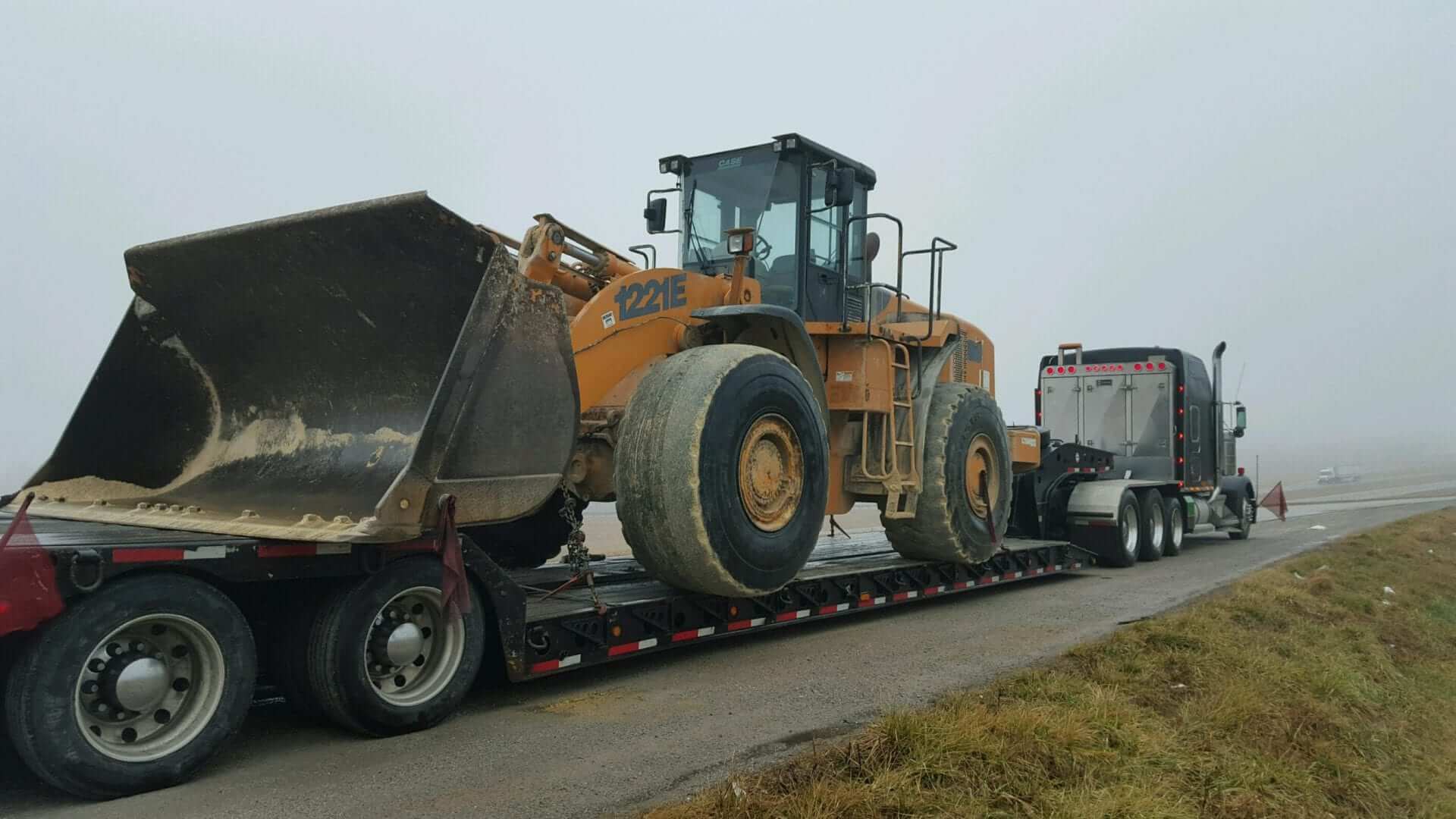
Wheel loaders, also called front-end loaders, are large wheeled machines with a hydraulic bucket mounted on the front. Their primary job is to scoop loose material from a stockpile and load it into a dump truck, a hopper, or onto a conveyor. They can also move pallets, logs, pipe, and other materials using specialty attachments in place of the standard bucket.
Unlike bulldozers, wheel loaders are optimized for speed and cycle time rather than pushing force. A fast operator can load a dump truck in three to four passes, keeping a cycle of trucks moving efficiently through a material handling operation.
Wheel loader transportation typically involves a step deck or lowboy trailer depending on the machine’s size. Large wheel loaders like a Cat 990 or Komatsu WA900 may require a multi-axle lowboy and oversize permits in most states.
Track loaders, a crawler-mounted variant, operate on the same principle but are better suited to soft ground and tighter work areas where a wheeled machine would lose traction.
5. Cranes
Cranes are the vertical dimension of any construction project. They lift steel, precast concrete panels, HVAC units, glass curtain wall panels, and other materials to heights that no other piece of equipment can reach. On active high-rise construction sites, tower cranes are visible from miles away, defining the city’s skyline as a project progresses.
The main types you encounter in construction:
Mobile cranes are mounted on a wheeled carrier and can travel on public roads under their own power between job sites, though they often require permits for width and load restrictions. They are set up and rigged at each location.
Crawler cranes move on tracks instead of wheels, allowing them to operate on soft ground and distribute their weight across a larger footprint. They are not self-propelled on public roads and require a heavy haul transport to move between sites.
Tower cranes are fixed cranes erected on a concrete base, growing taller as the building rises. They cannot be relocated without full disassembly. The components are transported by flatbed and reassembled on the new site.
Crane transport is among the most complex heavy haul moves we handle. Large crawler cranes must be broken down into components — upper works, lower works, boom sections, counterweights — transported separately on multiple trailers and reassembled at the destination.
6. Tractors
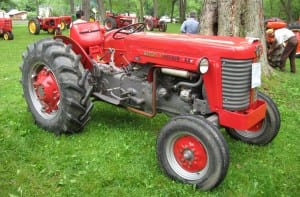
In a construction context, tractors are utility workhorses. A construction tractor can be fitted with a bucket, a backhoe, a blade, a ripper, a pallet fork, or a quick-attach system that lets the operator swap attachments for different tasks. They operate at slower speeds than loaders but are more versatile on smaller job sites where one machine needs to do multiple things.
Farm tractors, covered in detail in our farm equipment transport guide, follow similar transport requirements but are sized and configured differently from construction tractors.
Large construction tractors, particularly those fitted with full attachment packages, often exceed standard width limits during transport. The tractor itself and any trailing attachments need to be measured accurately before a quote can be confirmed, since the dimensions directly determine trailer type, permit requirements, and routing.
Tractor transport is one of our most frequent heavy equipment moves. Whether you are relocating a compact utility tractor or a large agricultural row crop machine, we match the load to the right trailer and handle the permit coordination.
How Hauling Heavy Equipment Gets Transported
Every piece of hauling equipment on this list exceeds standard highway legal dimensions in at least one measurement. That means specialized trailers and state DOT permits are required for any move on public roads.
The most common trailers used:
Flatbed trailers handle loads up to 48,000 pounds within standard height limits. Best for standard dump trucks, compact tractors, and smaller loaders.
Step deck trailers have a lower rear deck that provides additional height clearance for taller equipment without triggering overheight permit requirements on most routes.
Lowboy trailers have the lowest deck height of any trailer type, used for the tallest and heaviest equipment including large excavators, dozers, and crawler cranes.
RGN (Removable Gooseneck) trailers allow equipment with tracks or wheels to drive directly onto the trailer from the front after the gooseneck detaches, eliminating the need for ramps on low-clearance machines.
For an in-depth look at how we match trailers to loads, see our oversize load hauling page and our construction equipment transport service.
Having hauling equipment at the worksite on time is important for the success of any construction job. Your hauling equipment is necessary for a job well done and it needs to arrive not only on time but safely.
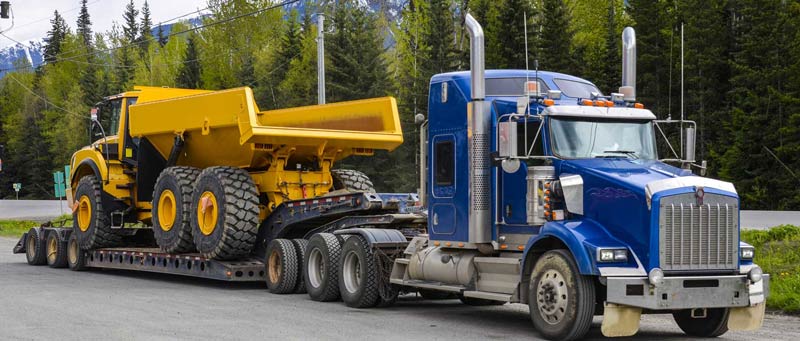
A trustworthy transportation company can help you ship your hauling equipment so that arrives where it needs to be and within the desired time frame.
We are experts in the transportation of trucks as well. Trucks are widely used to haul materials that can be found on the road. For example, there is a possibility to use trucks to move soil, sand, dirt and clay. With our expert services, you will be able to get the trucks transported from one place to another.
Now you have a clear understanding of how we will be able to help you with transporting heavy hauling equipment. Go ahead and contact us now to get more details about these services available to you.
6 Major Types of Hauling Equipment with We Will Transport It has the experience to transport your hauling equipment. If we can’t move it for you, we will find someone else who can. We have a list of trusted transporters that are ready and willing to move construction equipment.
What You Need Before Requesting a Quote
Before calling a transport company, have the following ready:
- Machine make, model, and year
- Transport dimensions: height with cab, width at widest point, overall length, operating weight
- Pickup and delivery locations including any access road restrictions or site conditions
- Whether the machine is operational or non-running
- Any attachments that will travel with the machine
Accurate dimensions matter. The difference between a machine that is 11 feet 6 inches tall and one that is 13 feet 8 inches tall can mean the difference between a standard permit move and a complex overheight routing job requiring a different trailer and additional lead time.
Contact us for all your hauling equipment transportation needs. We will transport your hauling equipment for you.
Ready to Move Your Equipment?
We Will Transport It has been moving construction hauling equipment across all 50 states for over 15 years. We handle heavy equipment transport for dump trucks, bulldozers, excavators, wheel loaders, cranes, and tractors with full permit coordination, trailer matching, and insurance coverage from pickup to delivery.
Get a free quote and tell us what you’re moving. We’ll handle the rest.