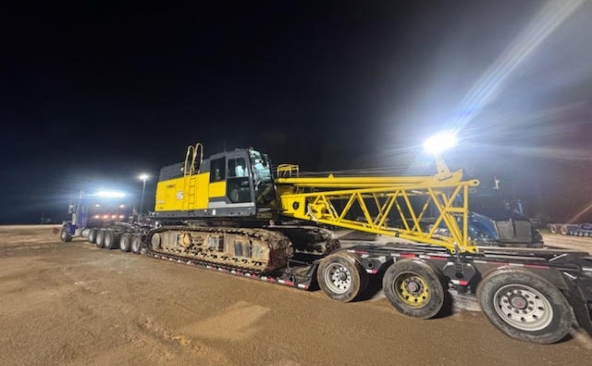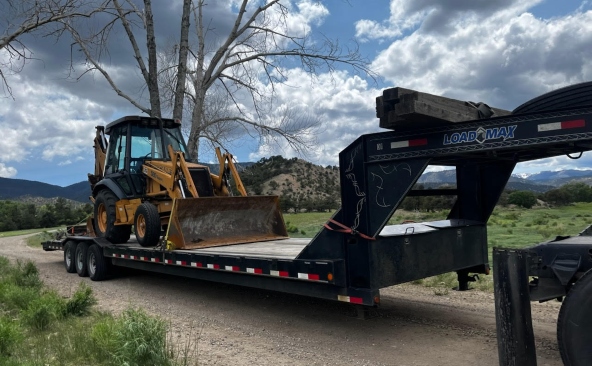
We handle Oregon heavy equipment shipping for contractors, farmers, and factories. Some loads are moved just a few miles to the next job site. Others travel hundreds of miles to a new location across the state. Either way, we apply the same level of care and preparation to every move.
Shipping heavy equipment in Oregon also means crossing some of the most demanding terrain in the country. Therefore, our drivers study each route before departure and account for elevation changes, low clearances, and weight-restricted roads. We do not guess our way through a haul. We plan it out completely so the equipment arrives without issues.

Transport Oversized, Overweight, and Industrial Machinery
We transport oversized, overweight, and industrial machinery in Oregon. Hauling oversized machinery at the industrial scale requires a specific combination of trailer type, axle configuration, securement technique, and permit coverage.
Hauling oversized loads like large industrial presses, processing equipment, and utility transformers involves planning on both ends of the move. Moving industrial equipment out of a building often means working around structural columns, loading dock limitations, and floor load restrictions. Our specialists coordinate with facility managers before pickup day so nothing delays the loading process.
Farm Equipment Transporters in Oregon
Combines, large tractors, sprayers, and wide equipment exceed standard road widths and require the proper permits to move on the highways. Our specialists obtain permits and plan routes to keep agricultural equipment moving during the narrow windows farmers depend on.
Agricultural equipment also presents unique loading challenges because many machines have folding sections, extended headers, or hydraulic attachments that need to be repositioned before loading. Our drivers handle the preparation at the pickup location so the equipment loads correctly.
Oregon Heavy Equipment Hauling Costs
The Oregon heavy equipment transport costs start at $2.00 to $5.00 per mile. The price to haul heavy equipment in Oregon depends on fuel prices, trailer requirements, and permit costs. A short local transport across a county costs less than a multi-day long-haul transportation with permits in different states.
Heavy equipment shipping costs also reflect the complexity of the move. Door-to-door delivery, expedited scheduling, and remote delivery locations each affect the final number. We provide a fully transparent quote for the heavy haul.
Forklift Hauling and Smaller Industrial Equipment
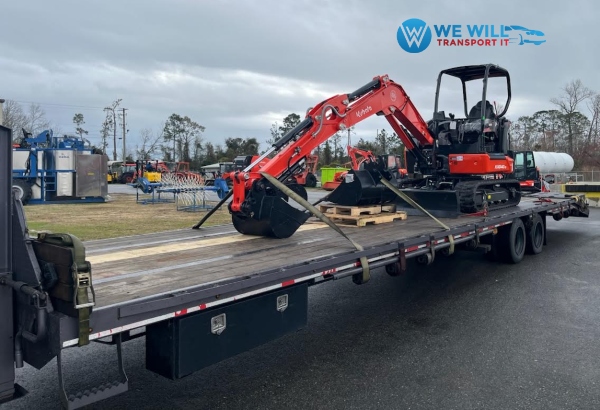
A warehouse that needs a forklift relocated to a new facility has the same need for reliable service as a contractor waiting on an excavator. We treat moves with the same level of attention, regardless of the machine’s size.
Additionally, machinery hauling services in Oregon extend to equipment inside facilities that need to be relocated. Our drivers use rigging equipment to move machines safely through tight spaces and onto the trailer without damaging the equipment or the building.
Oregon Heavy Equipment Moving With the Right Trailer
Oregon heavy equipment hauling starts with picking the correct trailer for the equipment. Using the wrong trailer causes equipment damage, failed roadside inspections, and serious safety problems. We use many different trailers, so we always have the right option available.
An RGN trailer is used when operable equipment needs to be driven directly onto the deck from the ground. RGN trailers work well for excavators and bulldozers because they remove the gooseneck and create a ground-level ramp. We use a lowboy trailer for tall machines that need to stay as close to the ground as possible. A flatbed trailer handles loads that fit within standard height limits and do not need a dropped deck. A Landoll trailer offers a sliding rear section for ramp loading at locations without a dock. A double-drop deck trailer offers the lowest deck height and can handle the tallest machinery.
Matching the right trailer to each load is something our specialized logistics specialists figure out before anything is moved. Additionally, we factor in axle count and weight distribution to stay within state bridge laws on every route.
Getting the Right Permits for Heavy Equipment Transport in Oregon
Before any oversized or overweight load moves on an Oregon road, a permit is required from the Oregon Department of Transportation (ODOT). This is not optional. Any oversized load that exceeds Oregon’s standard legal size and weight limits must have the proper paperwork in hand before it moves.
Oregon offers a few different types of permits depending on the situation.
A single-trip permit covers one move from one location to another. It is good for ten days and works well when hauling equipment once. If moving similar loads repeatedly throughout the year, an annual permit may be better. An annual permit covers multiple moves for up to 12 months and can save time compared to applying for a new permit for each haul.
For truly massive loads, Oregon requires a superload permit. A superload permit applies to equipment that exceeds normal oversize limits. These moves usually require an engineering review and a detailed survey of the route to make sure the roads and bridges can handle the weight. Finally, there is a variance permit, which covers unusual situations where standard permits do not fit the move.
As of May 2025, Oregon uses an online system called ORION, which stands for Oregon Routing Information Online. It is available around the clock, and our specialists apply for permits at any time of the day or night without waiting for office hours. This has made the whole process much easier for our drivers.
What Triggers the Need for a Permit?
Oregon’s standard legal limits are straightforward. If the heavy equipment goes beyond any of these, a permit is required:
- Width over 8 feet 6 inches
- Height over 14 feet
- Gross weight over 80,000 pounds
- Single axle over 21,500 pounds
- Tandem axle over 43,000 pounds
It is also worth knowing that permits in Oregon are route-specific. That means the permit is approved for a specific path, not just a general area.
Heavy Equipment Shipping Options in Oregon: Expedited or Next Day
We provide Oregon heavy equipment transport locally, intrastate, cross-country, and internationally. From same-day service in Eugene, Medford, Bend, and Klamath Falls to permit-secured moves over Santiam Pass or Cabbage Hill, and door-to-door shipping from Beaverton to Boston or overseas, we handle it all. Our Portland team coordinates rail intermodal when needed. Call (877) 880-5991 today for a free quote on your next heavy haul.
Local Oregon heavy equipment hauls can be done in the same-day or the next-day, while moves within the state, like over mountain passes, can take 1-2 days. Nationwide shipments typically take 4–7 days, and international exports can range from 2-8 weeks depending on the route and shipping method.
Oregon Heavy Haul Regulations: The Rules of the Road
Having a permit gets you started, but there are other regulations required to follow once on the road.
Escorts and Pilot Cars
Wide loads often require escort vehicles, also called pilot cars, to travel with them. The size of the load determines how many escorts are needed and whether they go in front, behind, or both. Oregon requires that escort vehicle drivers hold proper certifications. This is not something that can be skipped or worked around.
Travel Time Restrictions
Oregon sets limits on when an oversized load can move through specific areas. Cities and urban corridors have curfews that keep wide loads off the road. Some of the routes restrict nighttime transportation based on the width or height of the load. The permit will list the approved travel window, and drivers need to follow it.
Seasonal and Weather Restrictions
Winter in the Oregon mountains can stop a heavy haul from happening. Different routes through the Cascades and other elevated areas have restrictions on heavy loads when weather is bad. Low bridges on older county roads and rural state highways are something to check before the move, not during it. Bridge height clearances and posted weight limits have to be part of any route plan, especially when the route goes off the main interstates.
Special Cargo Rules
Equipment like cranes, booms, masts, and drilling machinery has its own securement rules in Oregon. At least two thirds of the total equipment length must be fully supported on the trailer. The rear overhang cannot go beyond one third of the total length. Anything that sticks out past the trailer has to be secured so it cannot move or bend while the truck is moving.
Insurance and Documentation
Proof of the insurance has to be available at all times. Permits must be obtained before the move starts, not after. Carriers coming from another state can use a valid out-of-state trip permit to operate in Oregon, but that permit still has to be physically present.
Major Routes for Heavy Equipment Transport in Oregon
Oregon has a solid road network that connects its cities, ports, farms, and industrial areas. Knowing which routes work best for oversize and overweight loads makes planning much easier.
Interstate 5 (I-5) — The Main North-South Corridor
I-5 is the backbone of freight movement along the entire West Coast, and Oregon is no exception. The highway runs about 308 miles through the state, starting near Ashland at the California border and heading north through Medford, Eugene, Salem, and Portland before crossing into Washington. For heavy equipment hauling between California and Washington, this is the go-to route. It handles high traffic volumes and heavier loads are moved to secondary highways.
Interstate 84 (I-84) — The East-West Lifeline
I-84 runs east to west and is the main route connecting Portland to the eastern half of Oregon and beyond. Starting at its junction with I-5 in Portland, it follows the Columbia River through the gorge, passing through Hood River and The Dalles before continuing east through Pendleton and Ontario all the way to the Idaho border. For equipment moving between the Pacific coast and inland states such as Idaho and Utah, I-84 is the primary route. Together, I-5 and I-84 carry well over 75 percent of Oregon’s truck freight by weight.
US Route 97 — Central Oregon’s Main Artery
US-97 runs north to south through central Oregon, starting at the California state line near Klamath Falls and stretching up to Biggs Junction, where it meets I-84. Along the way it passes through Bend, Redmond, and Madras. It is a busy and important route for equipment moving through the middle of the state. The speed limit is 65 mph, and it is worth noting that this is a two lane road in many sections, which requires extra care when moving wide loads.
Oregon Route 58 — Crossing the Cascades
OR-58 connects I-5 near Eugene to US-97 near Chemult, running across the Cascade Mountains. It is one of the better options for moving equipment between western Oregon and the central part of the state without having to go all the way up to Portland first.
US Route 101 — The Coastal Highway
Highway 101 runs along Oregon’s entire Pacific coastline, from Brookings near the California border all the way up to the Columbia River at the Washington state line. It connects coastal towns and gives access to Oregon’s coastal ports. Due to the winding, scenic nature of this road, it requires more careful planning for large loads than the main interstates.
Interstate 205 — Portland Metro Bypass
I-205 loops around the east side of Portland and connects I-5 in the south to I-5 again in Washington to the north, with a junction at I-84 along the way. For heavy equipment moving through the Portland area, I-205 is often the better choice to avoid the heavier urban traffic on I-5 through the city core.
Oregon’s Ports and How They Support Heavy Equipment Transport
Oregon’s ports are important for heavy equipment moving to or from international markets. The state has different ports that regularly handle the transport of oversized equipment.
Port of Portland
The Port of Portland is Oregon’s largest freshwater port and is located where the Willamette River meets the Columbia River. Its location at the intersection of I-5 and I-84 makes it one of the most accessible ports in the Pacific Northwest. It handles various types of cargo and is well-equipped to move heavy industrial equipment in and out of the region.
Port of Coos Bay
Located on the southern Oregon coast, the Port of Coos Bay is the deepest port between San Francisco and Puget Sound. That depth matters when you are moving large, heavy cargo by ship. The port’s marine facilities handle heavy equipment transport, and makes it a solid option for coastal and international shipments.
Port of Astoria
The Port of Astoria is right at the mouth of the Columbia River in northwestern Oregon. It handles both domestic and international shipments and has been an important part of the Pacific Northwest’s maritime network. Furthermore, for equipment arriving by sea and heading east, Astoria’s position at the start of the Columbia River corridor puts it in a strong spot logistically.